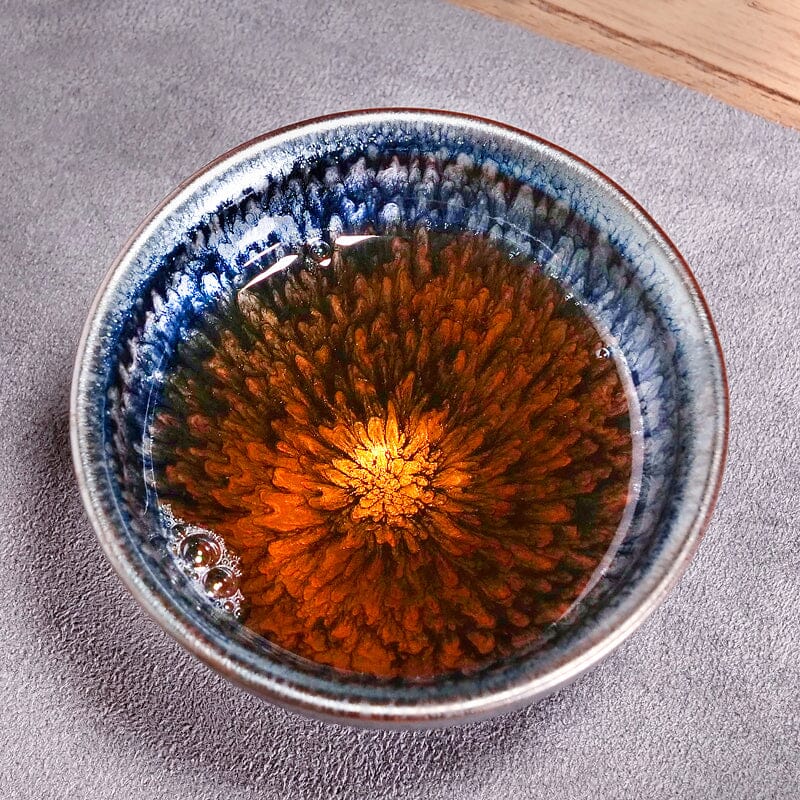
The Complete Guide to Tenmoku Glazes — Hare’s Fur, Oil Spot, Yohen and the Secrets of Jian Zhan Beauty
Chapter 5: The Complete Guide to Tenmoku Glazes — Hare’s Fur, Oil Spot, Yohen and the Secrets of Jian Zhan Beauty
Quick Answer: What Are Tenmoku Glazes?
Tenmoku glazes are traditional high-iron ceramic glazes famous for their deep dark surfaces and naturally formed patterns created during high-temperature kiln firing. In authentic jianzhan tenmoku bowls, patterns such as Hare’s Fur, Oil Spot, and Yohen are produced by mineral crystallization rather than painted decoration.
The beauty of tenmoku lies in transformation. A simple combination of clay, glaze, fire, and time can create surfaces that appear metallic, star-like, or even resemble flowing landscapes.
For centuries, ceramic artists have attempted to understand and reproduce these effects, yet the final results always contain an element of unpredictability. This connection between craftsmanship and natural creation is what makes tenmoku one of the most admired glaze traditions in the world of ceramics.
Understanding Tenmoku: More Than a Black Glaze
Many people first encounter tenmoku and describe it simply as a "black glaze."
However, this description does not capture its true complexity.
A high-quality tenmoku surface contains multiple layers of visual depth:
-
Deep black or dark brown background
-
Metallic crystal formations
-
Flowing mineral patterns
-
Subtle color reflections
-
Changes under different lighting conditions
Unlike painted decoration, the beauty of tenmoku comes from changes occurring inside the glaze itself.
During firing, iron-rich minerals move, separate, and crystallize. These microscopic changes create patterns that can only be revealed after the bowl leaves the kiln.
This is why each jianzhan tenmoku bowl carries a unique identity.
The Role of Iron in Tenmoku Glaze
The defining characteristic of tenmoku glaze is its high iron content.
Iron oxide acts as the key mineral component responsible for the dark color and crystal formation.
During kiln firing:
-
The glaze melts into a liquid state.
-
Iron compounds dissolve and move within the glaze.
-
Temperature changes affect mineral separation.
-
Crystals form as the glaze cools.
-
Light interacts with these crystals, creating visible patterns.
The same basic chemistry can produce completely different results depending on:
-
Clay composition
-
Glaze formula
-
Firing temperature
-
Oxygen level
-
Cooling speed
This explains why two bowls made from the same workshop can still develop different glaze appearances.
Hare’s Fur Tenmoku: The Classic Expression of Flowing Beauty
Hare’s Fur is one of the oldest and most recognizable tenmoku glaze styles.
The name comes from its appearance: thin streaks flowing vertically through the dark glaze resemble the soft texture of hare fur.
Historically, Hare’s Fur bowls were highly appreciated during the Song Dynasty because they created a beautiful contrast with white tea foam during tea competitions.
How Hare’s Fur Forms
During firing, the iron-rich glaze becomes fluid.
As the glaze moves downward along the bowl surface:
-
Iron minerals concentrate into streaks.
-
Crystal structures develop along these flowing lines.
-
Cooling preserves the pattern.
The final appearance depends on many factors:
-
Glaze thickness
-
Bowl angle
-
Kiln temperature
-
Mineral concentration
Characteristics of High-Quality Hare’s Fur Tenmoku
Collectors often evaluate Hare’s Fur by looking for:
Clear Flowing Lines
The streaks should appear natural and well-developed.
Strong Contrast
The pattern should stand clearly against the dark background.
Balanced Distribution
The effect should complement the shape of the bowl rather than appear random or uneven.
Smooth Surface
A refined glaze should maintain a harmonious texture.
Oil Spot Tenmoku: The Beauty of Mineral Crystals
Oil Spot is another legendary tenmoku style known for its sparkling circular patterns.
The name comes from the resemblance to droplets of oil floating on water.
Under light, these small crystal formations can appear metallic, silver, gold, or rainbow-colored.
How Oil Spot Patterns Form
Oil Spot patterns develop through a process of mineral separation.
During firing:
-
Iron-rich glaze reaches a molten state.
-
Iron compounds move toward the surface.
-
Mineral concentrations form circular crystal areas.
-
Cooling locks these formations into place.
The result is a surface filled with tiny reflective patterns.
No two Oil Spot bowls will have identical crystal arrangements.
Evaluating Oil Spot Tenmoku Quality
Collectors often consider several characteristics:
Crystal Size
Larger, clearly developed crystals are often highly valued.
Distribution
A balanced spread across the bowl creates visual harmony.
Metallic Reflection
Strong reflective qualities increase the visual impact.
Depth
The best examples show multiple layers rather than a flat surface appearance.
A high-quality Oil Spot bowl can appear different from every angle as light moves across the glaze.
Yohen Tenmoku: The Legendary Kiln Transformation
Among all tenmoku styles, Yohen is perhaps the most famous and mysterious.
The word Yohen (曜変) can be translated as "kiln transformation" or "unexpected change."
Yohen represents rare and extraordinary glaze results created under very specific firing conditions.
The Appearance of Yohen Tenmoku
A Yohen surface may display:
-
Deep blue tones
-
Purple reflections
-
Silver highlights
-
Golden edges
-
Rainbow-like colors
The colors are not painted onto the bowl.
They are produced when light interacts with microscopic mineral structures inside the glaze.
Why Is Yohen Tenmoku So Rare?
Yohen formation requires a very precise combination of conditions.
Small differences in:
-
Glaze chemistry
-
Kiln atmosphere
-
Temperature curve
-
Cooling process
can determine whether the effect appears or not.
Even experienced artisans cannot guarantee a perfect Yohen result every time.
This rarity is one reason Yohen has become one of the most treasured ceramic glaze effects.
Other Important Tenmoku Glaze Variations
Although Hare’s Fur, Oil Spot, and Yohen are the most famous, traditional tenmoku includes many other variations.
Silver Spot Tenmoku
Characterized by bright metallic crystal formations resembling silver particles.
Gold Spot Tenmoku
Known for warm golden reflections created by mineral interactions.
Blue Reflection Tenmoku
Displays cool blue tones under specific lighting conditions.
Modern Experimental Tenmoku
Contemporary ceramic artists continue exploring new glaze formulas while respecting traditional techniques.
Why Lighting Changes the Appearance of Tenmoku
One fascinating characteristic of tenmoku is that it appears different under different lighting conditions.
A bowl may look:
-
Deep black in soft indoor light
-
Metallic under direct sunlight
-
Blue or purple from certain angles
-
Golden when light reflects through crystals
This happens because the glaze surface contains microscopic structures that interact with light.
The bowl is not changing color—the viewer is seeing different reflections from the same complex glaze surface.
How Collectors Appreciate Tenmoku Glazes
Collectors usually consider several factors when evaluating a tenmoku bowl.
Historical Connection
Does it represent traditional Jian ware techniques?
Craftsmanship
Is the bowl carefully shaped and finished?
Glaze Development
Are the patterns naturally formed and visually balanced?
Uniqueness
Does the bowl have individual character?
Harmony
Do the shape, clay, and glaze work together?
A valuable tenmoku bowl is not necessarily the one with the most dramatic colors. True appreciation comes from understanding the relationship between craftsmanship and natural transformation.
Tenmoku Glaze and Modern Tea Culture
Today, tenmoku continues to inspire tea practitioners worldwide.
Its appeal comes from the combination of:
-
Historical tradition
-
Functional design
-
Artistic beauty
-
Meditation and mindfulness
Using a jianzhan tenmoku bowl creates a connection between modern tea drinkers and centuries of ceramic history.
The experience is not only about drinking tea—it is about appreciating craftsmanship, patience, and the beauty of imperfection.
Key Takeaways
-
Tenmoku glaze is a traditional high-iron glaze created through complex kiln reactions.
-
Authentic jianzhan tenmoku patterns are naturally formed rather than painted.
-
Hare’s Fur, Oil Spot, and Yohen are the most famous tenmoku glaze styles.
-
Iron minerals and kiln conditions determine the final appearance.
-
Yohen tenmoku is especially rare because it requires exceptional firing conditions.
-
Every tenmoku bowl has a unique surface because natural kiln transformation cannot be perfectly repeated.
Frequently Asked Questions About Tenmoku Glazes
Is tenmoku glaze always black?
No. Although it often appears dark, high-quality tenmoku can display blue, purple, silver, gold, and rainbow reflections.
Are tenmoku patterns painted?
Traditional tenmoku patterns are created through mineral reactions inside the glaze during firing.
What is the difference between Hare’s Fur and Oil Spot tenmoku?
Hare’s Fur features flowing streaks, while Oil Spot features circular crystal formations.
Why is Yohen tenmoku valuable?
Its rarity comes from the difficulty of achieving the unique mineral and firing conditions required for its formation.
Can every artisan make the same tenmoku glaze?
No. Even experienced artisans cannot perfectly duplicate natural kiln results.